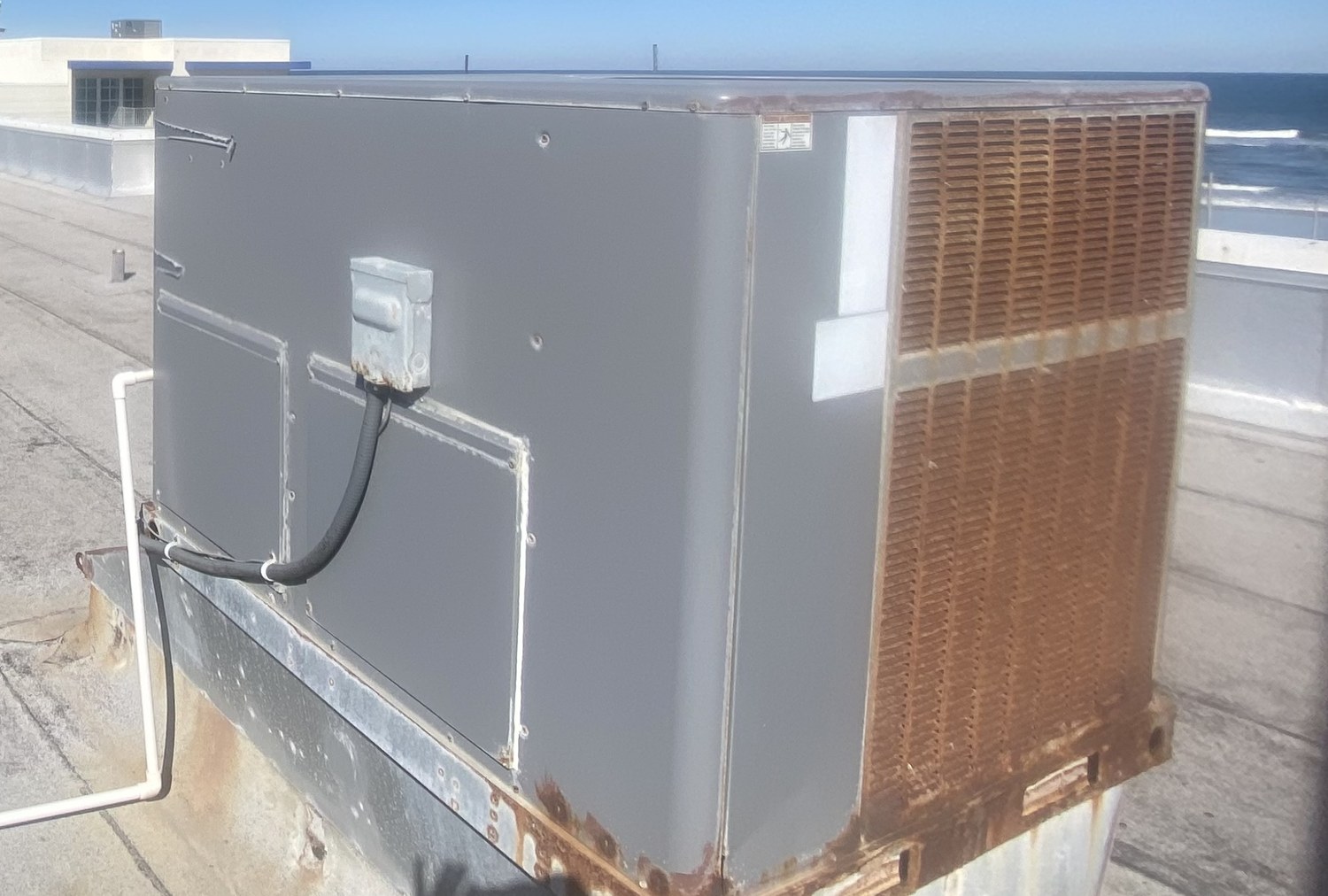
Anyone who owns or services air conditioning near the ocean has seen it: white crust on the coil, flaking fins, rusted fasteners, and a unit that fails years before it should. Salt air is the cause, and it is not limited to one region. It affects outdoor equipment on every ocean coastline, island, and harbor city.
It starts with salt and moisture
Salt particles carried in sea air settle on metal surfaces. When they meet moisture from humidity, dew, or rain, they form a thin salty film. That film conducts electricity, and that is what starts the damage.
Why it is faster than ordinary rust
Rust is a simple oxidation process. Salt corrosion is electrochemical: a reaction between metals and a conductive electrolyte, in this case salty water. It is faster and more aggressive than rust, and it often begins beneath the surface, invisible until the damage is advanced.
Galvanic corrosion between different metals
Outdoor HVAC equipment combines several metals in contact with one another. When two different metals touch in the presence of salty moisture, one becomes the anode and corrodes while the other becomes the cathode and is protected. The less noble, more reactive metal corrodes much faster, sacrificing itself to protect the other.
Which metals are most at risk
- Highly susceptible: aluminum, carbon steel, and cast iron.
- Moderately resistant: copper, brass, and bronze.
- More resistant: stainless steel, especially 316, along with titanium and nickel alloys.
Even stainless metals can corrode in coastal settings, especially in crevices or shaded areas where salty moisture lingers.
What this means for owners and installers
Salt does not stay on the coil. It settles on fans, housings, fasteners, and base pans, and keeps working wherever moisture lingers. Removing salt before it builds up is the most direct way to slow the process.
Learn more on our science of salt corrosion page, or see our frequently asked questions.
Salt-Safe, Inc. is a Delaware public benefit corporation in Daytona Beach, Florida, developing the Guardian, a patent-pending system that protects coastal HVAC equipment from salt air corrosion.